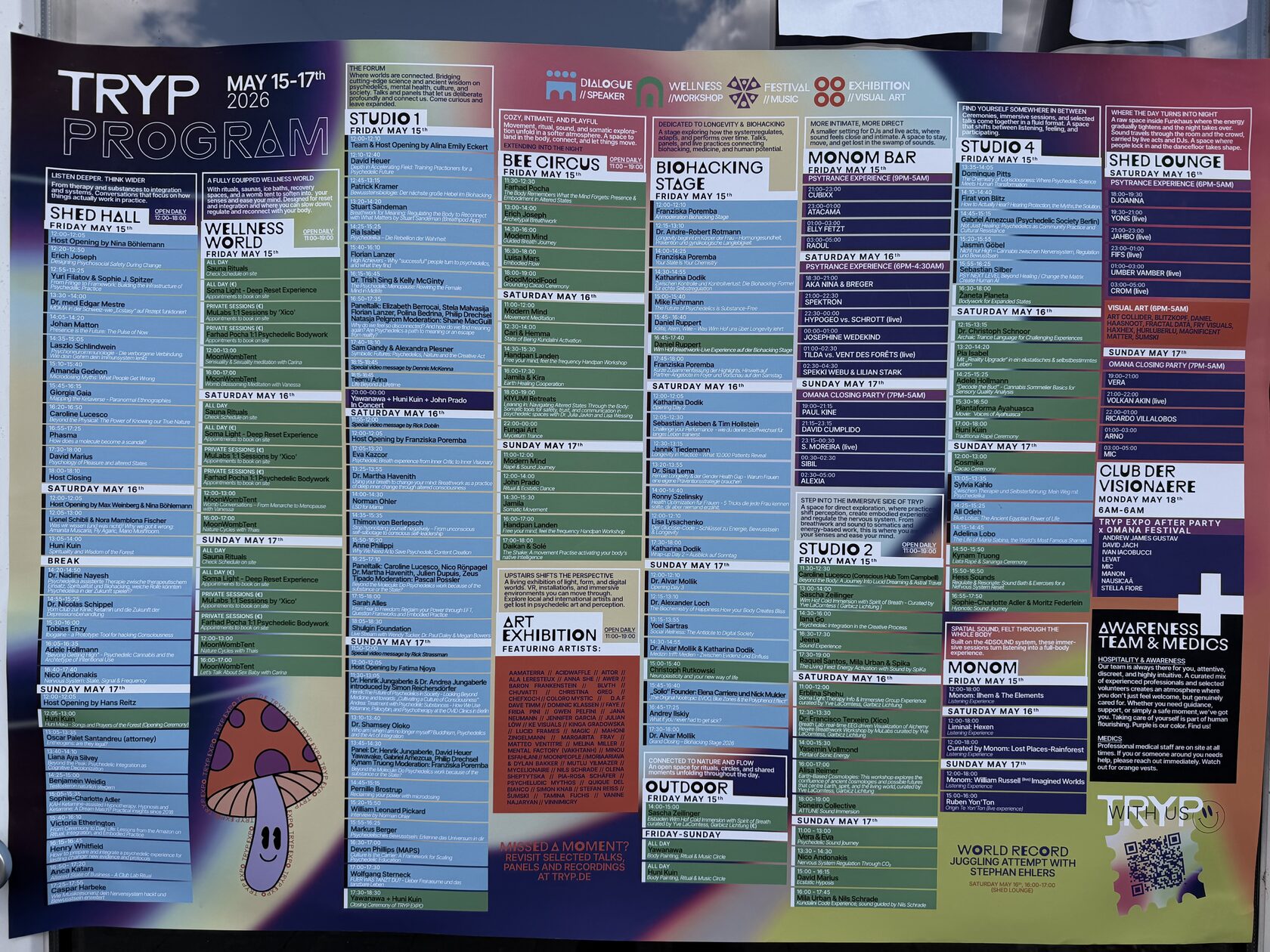
The Psychedelic Renaissance in Europe: TRYP Expo Berlin
I just got back from TRYP Expo in Berlin — Europe's first major gathering of its kind at the intersection of psychedelic science, mental health, wellness, and conscious culture. Three days at Funkhaus, surrounded by researchers, therapists, coaches, indigenous knowledge holders, biohackers, and curious minds from across the continent.
I went as an observer and a practitioner. I came back with a lot to think about.
Here are my honest takeaways — not a press release, not a highlight reel. What the field looks like right now, from someone working in it.
The Stigma Is Cracking — Faster Than Anyone Expected
Germany has never been the most psychedelic-friendly country culturally. So one of the most striking moments at TRYP wasn't a keynote or a panel — it was a casual observation: influencers, public figures, and mainstream wellness professionals openly talking about visiting clinics like OVID for ketamine-assisted treatment for depression.
Not in hushed tones. Not with disclaimers. Just matter-of-factly, the way someone might mention going to a physiotherapist.
That's new. And it matters. When stigma dissolves in Germany — a country with a strong pharmaceutical culture, serious regulatory frameworks, and a historically cautious relationship with altered states — it signals something is shifting at the cultural bedrock, not just at the fringes.
For anyone who has been sitting on the fence about exploring psychedelic-assisted approaches, the social permission structure is changing rapidly.
People Are Building the Community Infrastructure
One of the most energizing threads running through the entire expo was community. Not marketing communities, not follower counts — actual peer networks of support, knowledge exchange, and mutual accountability.
People are gathering in integration circles. They're forming practitioner networks. They're creating spaces where someone who just had a profound — or profoundly difficult — experience can find others who understand what that means.
This is exactly what the field needs, and exactly what clinical settings alone cannot provide. Healing doesn't happen in a session. It happens in the weeks and months that follow, in the conversations you're able to have, in the frameworks you have access to. Community is infrastructure.
This is part of why I run integration groups in Barcelona on Saturdays — and why seeing this dynamic play out at scale in Berlin confirmed for me that this is one of the highest-leverage things a practitioner can offer.
The Ethics Gap Is Real, and It's a Risk
Here's the uncomfortable observation: the field is growing faster than its ethical standards.
There are no universally agreed-upon frameworks for how a psychedelic integration coach should operate. No clear standards for informed consent. No shared definition of scope of practice. No accountability structures for when things go wrong.
This isn't a fringe problem — it came up repeatedly in conversations and panels. When a space scales quickly without ethical scaffolding, it creates real risks: for clients who don't know what good practice looks like, for practitioners who are learning as they go, and for the field's credibility as a whole.
I'm not saying this to be alarmist. I'm saying it because the people who take ethics seriously need to be vocal about it — and because as someone choosing to work with integration, your practitioner's ethical framework should be one of your first questions.
The Research Molecule Market Is Running Wild
Alongside the therapeutic conversation, there's a parallel universe at TRYP that's worth naming: the research chemical space is booming.
Novel psychoactive compounds — some structurally adjacent to classical psychedelics, some entirely new — are being developed, marketed, and consumed with very limited safety data. The regulatory grey zones that allow this are narrow and shifting.
I hold no moral judgment about this. But I do hold a practical one: without integration support, without set and setting, without a container of any kind, novel experiences with novel molecules in novel contexts is a high-risk combination. The enthusiasm is real. The guardrails are thin.
This Is No Longer Just About Healing Trauma
Perhaps the most significant conceptual shift I noticed at TRYP — and one that mirrors what I'm seeing in my own practice — is the expanding frame around why people engage with entheogens.
The early wave of psychedelic research focused, rightly, on treatment-resistant conditions: PTSD, major depression, end-of-life anxiety. That work is vital and ongoing. But the conversation has moved.
Increasingly, people are approaching entheogens not as medicine for something broken, but as tools for becoming more fully themselves. Personal growth. Expanded self-awareness. Navigating major life transitions. Finding clarity around purpose and values.
This is not a fringe position anymore. It was represented across panels, workshops, and exhibitor conversations. The frame is shifting from "fixing pathology" to "supporting flourishing."
That shift changes who the work is for. It's no longer just for people in crisis. It's for executives, creatives, leaders, and anyone doing the serious work of understanding themselves.
Integration Is Finally Getting the Attention It Deserves
For years, integration was the afterthought — the thing mentioned briefly at the end of a retreat or session before people dispersed. That's changing.
At TRYP, integration had its own panels, its own workshops, its own dedicated conversations. There's a growing recognition that the experience itself is only a door — what matters is what you do with what you find on the other side.
This is where the real work happens. This is where insights either become lasting change or dissolve back into the noise of daily life. And this is where a skilled guide makes the most difference — not during the session, but in the months that follow.
The Indigenous Knowledge Question Remains Unresolved
One of the most nuanced and important conversations at TRYP — and one that the field is still fumbling with — is the relationship between Western therapeutic frameworks and the indigenous traditions that have worked with plant medicines for generations.
There's genuine effort to learn from Amazonian and Mesoamerican knowledge systems. There are also real concerns about extractive dynamics — taking the practices and leaving behind the cultural and spiritual context that gives them coherence, while the communities who held this knowledge for millennia receive little acknowledgment or material benefit.
I don't have a clean answer here. Neither does the field. But the fact that it's being named openly at events like TRYP is a necessary step. Anyone working in this space should be sitting with these questions rather than bypassing them.
Formal Therapy Is Available — But Unaffordable for Most
There's a tension that no one at TRYP could fully resolve: the most clinically validated forms of psychedelic-assisted therapy are becoming available, and they cost several thousand euros per course of treatment.
This is not a small barrier. It means that in practice, the people most likely to access formal MDMA-assisted therapy or psilocybin-assisted therapy are those who are already economically privileged. The people most burdened by treatment-resistant depression, PTSD, and addiction — who disproportionately come from less privileged backgrounds — are least likely to afford it.
This gap between what the science shows is possible and who can actually access it is one of the defining ethical challenges of the next decade in this field.
In the meantime, this is partly why integration coaching, group integration work, and peer community matter so much — they're not replacements for clinical therapy, but they represent access points that don't require €5,000 and a clinical referral.
What This Means If You're Considering This Work
If you've had a psychedelic experience — whether in a clinical setting, a retreat, or independently — and you're trying to make sense of it, the landscape of support has genuinely expanded. Communities exist. Practitioners are available. The conversation is more open than it has ever been.
If you're curious about psychedelic-assisted approaches but haven't yet taken a step, the field is maturing in ways that make informed exploration more possible.
And if you're navigating either of these from the Barcelona area or online, I run individual integration sessions and weekly integration groups. The first session is free — you can find it at https://entheogen.expert/services
The door is open. What you do with that is yours to decide.
Vladislav runs entheogen.expert — a bilingual (English and Russian) coaching and integration practice focused on the therapeutic and developmental potential of psychedelics. He hosts a podcast, leads integration groups in Barcelona, and works with individual clients internationally.