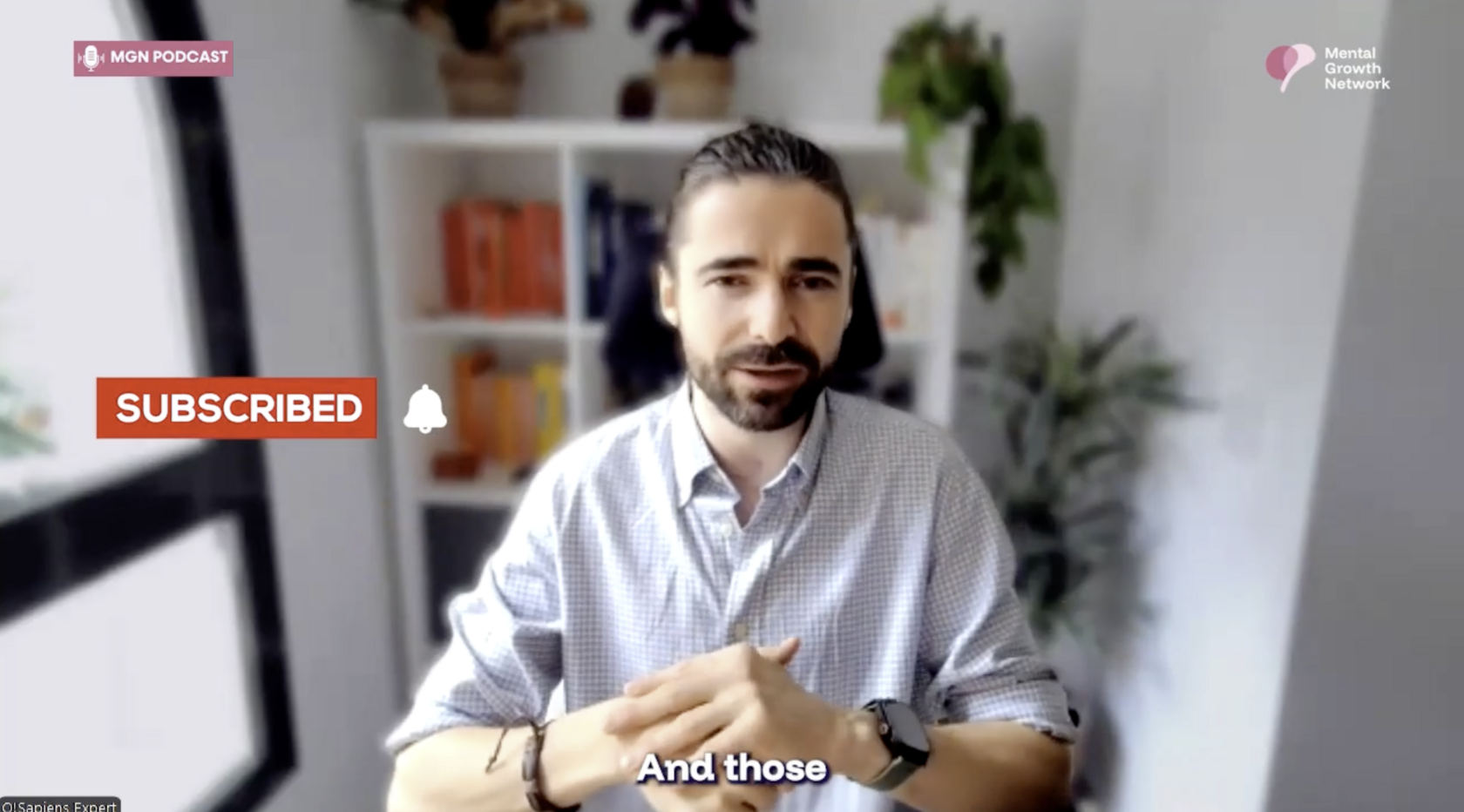
Psychedelics, Mental Health & The Future of Healing: Reflections From My Conversation on the Mental Growth Network Podcast
In a recent episode of the Mental Growth Network Podcast, hosted by digital health expert Emi Androm, I had the opportunity to speak openly about a topic that has defined much of my life’s work:
How psychedelics (or, as I prefer to call them, entheogens) intersect with mental health, trauma recovery, and human development.
For many mental health and neuroscience professionals, psychedelics remain a controversial subject. Yet the science has evolved, the evidence has grown, and a new paradigm of healing is emerging.
This blog post expands on the conversation we had — offering a clear, structured look at the science, the risks, the therapeutic potential, and the future direction of psychedelic-assisted mental healthcare.
My Journey: From Corporate Burnout to Evidence-Based Entheogenic Coaching
I was born at the crossroads of Europe and Asia, in the Ural region, and spent much of my early career in the corporate world — negotiation consulting, commercial leadership, strategic marketing. It was fast, demanding, intellectually stimulating… and ultimately unsustainable.
After years of chronic stress and a collapse in wellbeing, I experienced a severe emotional and physical burnout.
At the same time, I was battling a rare autoimmune disease — ankylosing spondylitis — which once left me half-paralyzed. Over the years, through major lifestyle changes, disciplined self-education in biology and neuroscience, and deep exploration of mind-body healing, I brought myself into remission and eventually discontinued all pharmaceuticals.
Parallel to this journey, for more than 23 years I explored altered states of consciousness through psychedelics. Long before the current scientific wave, I discovered — through personal experience — their capacity to bring unresolved trauma to the surface, open emotional clarity, and catalyze profound psychological growth.
Later, I validated those experiences with science:
— UC Berkeley’s “Psychedelics & The Mind”
— EMBARK training for clinical psychedelic trials
— Psychedelic Coaching Institute certification (combining neuroscience and entheogenic integration)
This combination of lived experience, formal training, and scientific literacy now forms the foundation of my work as a psychedelic-assisted coach, mental health educator, and creator of the O!Sapiens framework.
What Psychedelics Actually Do in the Brain
One of the most important parts of the podcast was clarifying foundational science.
Psychedelics are not “happy pills” or “hallucinogens” in the recreational sense.
They are non-specific amplifiers of consciousness that temporarily soften or dissolve the barrier between the conscious and unconscious mind.
Two metaphors I often use:
1. The Dam
The unconscious mind is like an ocean held back by a dam.
Psychedelics dissolve that dam — allowing suppressed memories, emotions, beliefs, and traumas to rise to the surface.
2. The Mariana Trench
In daily life, we float near the surface of awareness.
Psychedelics allow us to dive deep — into the most hidden layers of psyche, where trauma, fear, and existential questions reside.
This process is made possible by several key neurobiological mechanisms:
• Activation of 5-HT2A receptors
Leads to increased entropy, cognitive flexibility, and temporary dissolution of rigid thought patterns.
• Reduced activity in the Default Mode Network (DMN)
Associated with reduced rumination, decreased self-referential thinking, and the experience known as “ego dissolution.”
• Increased neuroplasticity
Psychedelics open “windows of learning,” allowing people to rewire habits, beliefs, and behaviors much more rapidly.
• Modulation of the amygdala
Many psychedelics reduce fear responses, enabling safer access to traumatic memories.
This combination is why psychedelics can catalyze breakthroughs in depression, PTSD, addiction, emotional regulation, and stress resilience.
Where Psychedelics Show the Strongest Clinical Evidence
During the podcast, we discussed the top areas where research is strongest today.
1. PTSD (MDMA-assisted therapy)
MAPS Phase III trials showed over 70% of participants no longer met the criteria for PTSD after MDMA-assisted psychotherapy.
It is one of the most successful mental-health interventions ever recorded.
2. Treatment-Resistant Depression (Psilocybin)
Clinical studies at Johns Hopkins, Imperial College London, and others show rapid, durable improvements after 1–2 psilocybin sessions combined with therapy.
3. Substance Use Disorder
Ibogaine, psilocybin, DMT, and ketamine show strong results in treating:
— opioid dependency
— alcohol dependency
— nicotine addiction
In some cases (ibogaine), patients experience a near-complete interruption of cravings.
Other promising areas include migraines, cluster headaches, chronic pain, and existential distress at end of life.
Stress, Memory & Emotional Healing: Why Psychedelics Improve Resilience
A major theme of the episode was how psychedelics change the way we relate to stress and memory.
1. Stress Resilience
People often emerge with a philosophical calmness:
A deeper sense that life’s problems are small compared to the vastness of experience itself.
This results from:
— emotional release
— ego dissolution
— decreased amygdala reactivity
— increased neural flexibility
2. Trauma Memory Integration
Psychedelics allow people to revisit traumatic memories without being overwhelmed.
This is one of the reasons they are uniquely powerful for PTSD.
3. Enhanced learning during neuroplasticity windows
For days or even weeks after a journey (depending on the substance), the brain is more flexible.
This is the ideal period for:
— building new habits
— learning emotional regulation
— changing cognitive patterns
— restructuring identity
Risks, Contraindications & Why Set and Setting Matter
I emphasized strongly:
Psychedelics are not for everyone — and context is everything.
❗ Contraindications
— predisposition to schizophrenia
— bipolar disorder (mania)
— certain medications (e.g., MAOIs, SSRIs with ayahuasca)
— heart conditions (particularly with ibogaine)
❗ Psychological risks
Not from the substance itself, but from:
— unsafe environment
— untrained facilitators
— lack of preparation
— lack of integration
— unresolved trauma surfacing too quickly
❗ The myth of the “bad trip”
There are no bad trips — only difficult trips.
And difficult experiences are often where the deepest healing occurs, if the person is supported properly.
Set = Mindset
Enter prepared, grounded, emotionally stable.
Setting = Environment
Safe, quiet, controlled, free of interruptions.
Sitter or guide
No one should undergo a high-dose session alone, ever.
Medical Protocols vs. Indigenous Traditions
We explored how the Western medical model differs from indigenous approaches:
Medical model
— sterile
— clinical
— structured
— protocol-based
— therapist-led
— expensive
Indigenous model
— community-centered
— spiritual
— rooted in ritual
— connected to nature
— emotionally supportive
Neither is superior — they serve different purposes.
What matters is safety, intention, integration, and respect.
Training, Education & Safe Professional Entry Points
For mental health professionals considering entering the field, I recommended:
Trusted organizations & trainings
— Open Foundation (Netherlands)
— ICPR Conference (2026)
— MAPS (US)
— Mind Foundation (Germany)
— Chacruna Institute
— Psychedelic Coaching Institute
— EMBARK
Reliable information sources
— Psychedelics Today
— Psychedelic Science Review
— Psychedelic Alpha
— Johns Hopkins Center for Psychedelic & Consciousness Research
Most important rule:
Do not trust self-proclaimed “gurus.”
Vet every practitioner thoroughly.
Psychedelics can heal — but unethical facilitators can harm.
Toward a Responsible, Science-Based Future
Psychedelic therapy is not a miracle cure.
It is not for everyone.
It does not replace therapy, lifestyle change, or personal responsibility.
But it is one of the most promising frontiers in mental-health science.
When used with care, preparation, and professional guidance, psychedelics can:
— help people resolve trauma
— break addiction cycles
— reduce depression
— process grief
— increase emotional resilience
— facilitate profound personal insight
— open space for change
This is why I continue investing my time, research, and work into this field — and why conversations like the one on the Mental Growth Network Podcast matter so much.
We are witnessing not only a scientific renaissance, but a cultural one — a reawakening of humanity’s relationship with consciousness, healing, and self-understanding.
Listen in full here: link to podcast episode